SACOSS Election Platform Highlights Challenges in Regional Areas

SACOSS Election Platform Highlights Challenges in Regional Areas

South Australia’s regional communities deserve more consideration from all parties in the leadup to the 21 March state election, according to the South Australian Council of Social Service (SACOSS).

SACOSS is the peak body for the state’s community services and non-governmental health sectors, and in launching its election policy platform it has highlighted issues in regional South Australia.

The policy proposals have been developed and put to government over the last year, but are now being released publicly and SACOSS has written to all parties seeking a response in the lead to the state election. SACOSS will publish a report card scoring the parties on their policies and responses in these key areas in the week before the election.

The SACOSS platform has 11 specific proposals across 5 key areas: community service funding, housing, energy, human rights, and health. In each of these areas, there are specific challenges or impacts on regional communities.

Government funding of community services generally has not kept pace with rising costs, but there are additional costs of providing community services in regional areas, and there are particular difficulties of attracting and retaining staff that need to be addressed. The community sector needs a funding boost, adequate indexation and a workforce development plan.

Housing availability and affordability is an issue across the state, but in regional South Australia:

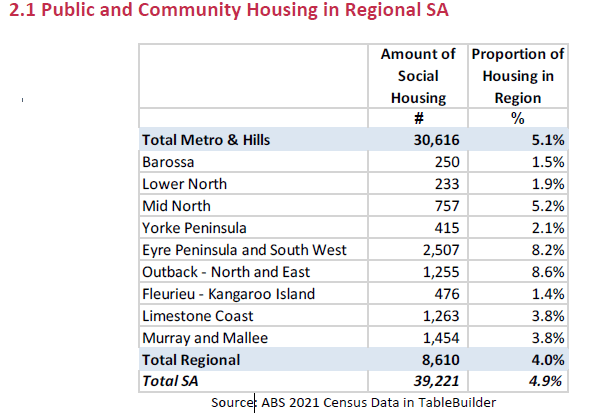
  • There are proportionately fewer public houses than metropolitan Adelaide (see attached data)
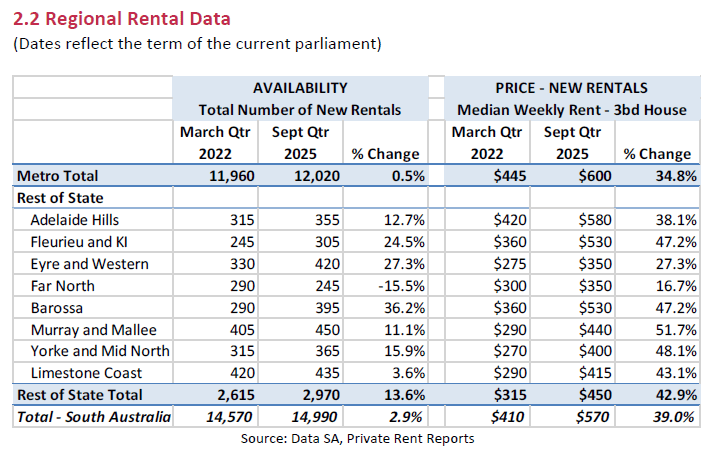
  • The price of new rentals has gone up faster for almost all regional areas than in Adelaide (see attached data)
  • Service providers report a chronic lack of emergency housing and a hidden problem of homelessness.

We need more public housing, caps on rent increases in existing tenancies, and more funding for homelessness services.

Energy policy looks different in regional areas where not all the state is connected to the national energy market and extreme temperatures heighten the need for thermal efficiency and good quality housing. SACOSS is calling for mandatory energy efficiency standards and a roadmap for electrification across the state.

Human Rights are universal, but a South Australian Human Rights Act could be an important tool requiring governments to consider access to services and supports for people in regional areas. SACOSS is calling for consultation to begin towards a Human Rights Act.

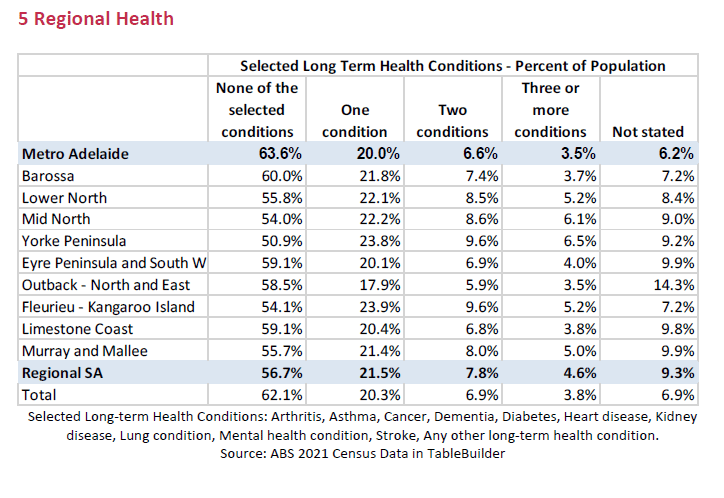
Health outcomes are worse in regional areas (see attached data) and the People’s Health Voice has already been working with regional communities to highlight health inequities, but funding is needed to continue and expand this project.

Full details of the SACOSS platform are available on the SACOSS website: https://sacoss.org.au/sa-election-2026/.

Quotes attributable to Dr Rebecca Tooher, SACOSS Director Policy and Advocacy

The SACOSS platform focuses on what should be key concerns for all parties to address inequality and assist those who are most in need in South Australia.

Our regional platform is not a comprehensive list of policies and investments required in regional areas, but it is a regional lens on SACOSS’ broader state election policy platform and it highlights the specific regional requirements in relation to those policies.

The issues we are highlighting will come as no surprise to people in regional areas, but they are issues and perspectives that are not always considered in metropolitan policy-making.

We look forward to hearing how the parties at this election will respond to the key issues and proposals in our platform.

Quotes attributable to Shane Maddocks, ac.care CEO

The cost‑of‑living crisis has become a sustained pressure in country communities that is hitting disadvantaged people the hardest, especially those already dealing with complex challenges.

It begins with the most basic human right: safe, affordable housing. Without a stable home, everything else becomes harder.

We need continued investment in genuinely affordable housing options, along with appropriate concession payments that allow people on low income to meet their essential needs.

It should never be the case that people are forced to choose between staying cool in summer or warm in winter, and keeping a roof over their heads. Yet these are the very real decisions many country people face every day.

We also need strong investment in community services. The more support available, the earlier we can step in, help people navigate challenges, and reduce the severity of issues before they escalate.

Early support gives people the best chance of building a more stable and secure life.
 

Scroll to Top

JEREMY BROWN

Jeremy is currently the Chief Executive at Uniting Communities and is deeply committed to cultivating a strong, values-driven organisational culture that places people and community at its core. His leadership style is grounded in empathy, innovation, and strategic growth, ensuring that Uniting Communities continues to deliver inclusive and impactful services to more than 80,000 South Australians each year.

His previous roles include Chief Operating Officer of Novita Services and Chief Operating Officer of Baptist Care (SA). He has also had a long-standing association with SACOSS where he served as a member of their Policy Council.

MICHELE WACHLA

Michele is an accomplished social services professional with a dual background in Social Work and Business, bringing over 18 years of experience to her work. She has developed a deep understanding of the unique challenges and opportunities within Regional, Rural, and Remote (RRR) environments, particularly in South Australia. Michele is a recognised leader, known for her expertise in designing and implementing place-based initiatives that address the complexities of RRR communities. Her work is underpinned by strategic planning, effective resourcing, and a strong focus on policy review and advocacy to ensure that services remain relevant, equitable, and sustainable. Michele’s commitment to community-centred approaches drives meaningful outcomes, nurturing resilience, and growth across regional South Australia.

KHATIJA THOMAS

DAVE ADAMSON

Dave moved to Australia following a 30-year academic career in the UK. He has since worked in the Community Housing sector and authored the 2016 Towards a National Housing Strategy, and helped to establish the Everybody’s Home campaign. He also researches the interface between poverty and climate change and actively supports the United Nations Sustainable Development Goals. He has worked with government at all levels and has experience of policy development and evaluation. He is co-author of Sustainable Places: Addressing Social Inequality and Environmental Crisis (2022, Routledge). In his spare time he plays and builds guitars.

ROHAN FEEGRADE

Rohan is an experienced and forward-thinking CEO, senior executive and board director with demonstrated expertise across the not-for-profit, private and government sectors. Currently CEO of Lutheran Care, he has proven record for creating substantial organisational, stakeholder and client value, and has extensive experience in strategically positioning organisations for transformational change and growth within the health, disability, education and community service sectors. Rohan is a socially responsible professional, genuinely passionate about creating opportunities for people who live with disadvantage and disability, always acting ethically to serve those he works with and for.

JANE MUSSARED

Jane has worked in for purpose and government health and human service settings throughout her career. In June 2024 she returned to SA and joined the Maggie Beer Foundation as CEO following 20 months based in Canberra as an Advisor to the Federal Minister for Health and Aged Care. Previously she was Chief Executive of COTA SA and before that an executive of ACH Group. Jane served on a range of boards and committees prior to moving to Canberra, including the SACOSS Policy Council until 2022, as chair of the South Australian Circus Centre and as a non-Executive Director with the Maggie Beer Foundation.

NANCY PENNA

Nancy has than 30 years of experience in South Australian community services, and a a unique understanding of the political and social landscape and the issues and opportunities facing South Australia. Currently responsible for the strategic and operational oversight of AnglicareSA’s community services portfolio, she has previously held executive roles in government within child protection and disability, with her executive experience underpinned by her earlier career as a social worker in child protection and youth justice. She is also Chair of the Child and Family Focus South Australia (CAFFSA) Board and most recently on the Housing Security for Older Women Taskforce.

NICOLE CHAPLIN

Nicole is a dedicated and experienced youth support professional, specialising in solutions for disadvantaged young people in South Australia. As CEO of St John’s Youth Services, she oversees innovative programs like youth110 and Foyer Port Adelaide. With over thirty years in the community sector, Nicole has built extensive networks and her expertise spans governance, service delivery, policy development, and partnerships. Recognised with the 2018 AHI Inspirational Leader Award, Nicole is an active participant in housing and homelessness networks. She holds leadership roles in various organisations, including Anglicare Australia’s National Reconciliation Network.

EMMA CROSBY

Emma is a chartered Accountant with more than 15 years experience as a board member, finance and business professional, strategic advisor and company secretary. She has strong values and a passion for enabling and leading organisations to meet its operational and strategic direction through long-term financial sustainability, operational efficiency, innovation, leadership, transformation and partnerships. As Treasurer and Board member at SACOSS, she is committed to successfully leading and making a purposeful impact to the organisation and its stakeholders.

David PANTER

David has worked in health and social care for almost 45 years, over half of which has been as a Chief Executive. In the UK he initially worked in the NHS and more latterly in local government, where he was Chief Executive of Brighton & Hove City Council. In 2004 David was recruited to the South Australian public health system for over 10 years leading reforms including the development of the new Royal Adelaide Hospital. From 2015-2022 David was the Chief Executive of not-for-profit aged care provider ECH. At the end of January 2022 David became the Chief Executive at Minda, SA’s largest provider of services to people living with an intellectual disability.